
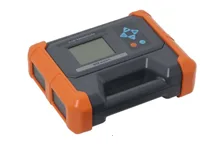
Details & specifications
In the power industry, cable identification has to be made using very strict criteria, because it is related to personal safety and mistakes may result in damage to plant. The T-710 is a high-performance cable identification instrument, consisting of a signal transmitter and a receiver. It is used to accurately identify a specific cable among a bundle of cables. The system is suitable for on-line use (3-core armoured cable only) or for off-line cables.
Features
Flexible clamp for receiving signals
Load current measurement for 50Hz/60Hz cable
Direct output or clamp coupling
Adjustable, high output power
Automatic impedance matching
Clear identification of cable
High-capacity lithium-ion battery
Lightweight, sturdy housing
High-accuracy digital sampling and processing with extremely narrow passband reception
Immunity from interference
Suppression of power frequency and harmonic interference from adjacent cables and pipelines.
Specifications
Transmitter
Output frequency: 640Hz or 1280Hz
Output power: max 10W in 10 steps
Output voltage: max.150Vpp
Overload/short circuit protection
HMI: 320 x 240 pixels LCD
Internal battery: 4 nos.18650-, 7.4V, 6.8 Ah
Dimensions 280 x 220 x 90mm
Weight 2.3Kg
Receiver
Input mode: Flexible clamp
Active detection frequency 640Hz, 1280Hz
Passive detection system frequency 50/60Hz
Current measurement: 1 – 1000A±3% AC
HMI: 800 x 480 pixels LCD
Battery: 2 nos. 18650 battery, 3.7V 6.8Ah
Dimensions: 220 x 125 x 55mm
Weight 0.9kg
Operating Environment
Temperature: -10oC to +50oC
Relative Humidity: 5 – 90%
Ingress protection IP54
Application
Smart Clamp Method
Smart clamp identification using signal transmission is the clearest and most powerful method for cable identification. The frequency of the receiver is set at 1280 Hz or 640Hz, depending on the cable length.
For a dead cable, direct connection is used, with the best connection being core-earth. If this is not convenient a phase to sheath connection may be used, but the sheath should not be connected to earth. For live cables, the clamp coupling method is preferred.
On the target cable, the receiver will identify the frequency and other confirmatory parameters and indicate to show it is correct. A negative indication shows that an adjacent cable has been measured.
Set Reference Method
The user will set a reference for a particular cable which will identify the phase angle and magnitude of the current in the cable. If the detector is moved to another point of the cable it will compare the new parameters to the set reference. If they match the system will indicate and the cable is identified. Alternatively, indicates the cable has failed to meet the reference criteria and it is concluded that it is not the target cable.
Customer reviews
No reviews yet.